Community Shut Out Again! TriCare – planning for success or planning for failure?

When are our voices going to be heard? More than 800 submissions, several public protest meetings and a comprehensive campaign by ‘Protect Taringa’ and still the reasonable concerns of the community were not addressed. 

The Residential Care and Retirement Facility, which was proposed by TriCare at 52 Seven Oaks Street, Taringa received major backlash when it was made known that Brisbane City Council (Council) was being asked to approve the construction of 3 high-rise buildings. The community identified many concerns about the development including the height, scale, bulk, traffic, parking and removal of existing protected vegetation onsite. These issues conflicted with several codes within the Brisbane City Plan 2014. Now, community members are opening up about the lack of involvement they were entitled to in the development application assessment process.  

Community notification or appeal not permitted

Monique Mayze, a corporate communications practitioner who led the ‘Protect Taringa’ campaign, believes the planning process did little to engage the community. This was mainly due to the code assessable rules the TriCare development was classified under. These rules don’t require the developer to give public notice of its application and don’t allow the community any right of appeal against Council’s decision. 

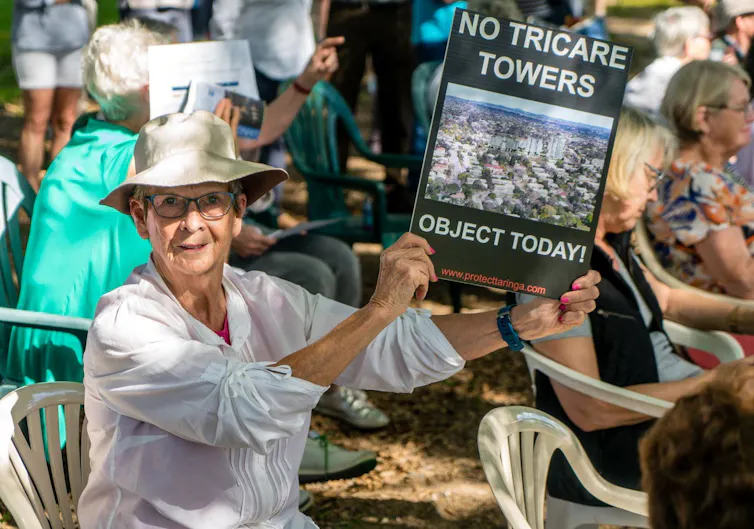
Despite this, the community did everything it could to make its voice heard. They voiced their concerns through a coordinated campaign of community meetings, social media, letterbox drops, informal submissions to Council and media engagement. The community tried everything.  

The Protect Taringa community group also invited representatives of the main political parties (LNP, Labor and the Greens) to speak at its community meetings which saw more than 300 members of the public attend.  In response to this outpouring of community concern, Council was forced into action. It initially refused TriCare’s application despite some amendments being made by the developer.  

pastedGraphic.png

“If the community did not take action, the Council would not have responded,” stated Monique Mayze. 

Yet this support from Council didn’t last long because, when TriCare commenced legal proceedings against Council, Council backed down and a negotiated deal was made between Council and TriCare with no opportunity for involvement by the community.  For the community the new deal did not adequately deal with the height, bulk and scale of the development and still allowed for the removal of protected vegetation.  

Despite the local councillor at the time, Cr Julian Simmonds, assuring the community that Council would defend its refusal vigorously to the Court, it failed to do so. The Planning and Environment Court was not given the opportunity to assess the development on its merits, but rather on whether the amendments to the plans, agreed between Council and the developer, represented minor changes. The Court found the changes were minor under the terms of the Act. The community’s concerns were not addressed as part of that decision.  

The community had no knowledge of this deal until a judgment was posted on the court website. The community’s reasonable concerns were not properly addressed in this final decision. Instead, they were completely shut out.

Concerns Not Answered

What was the purpose of making submissions if our concerns were not going to be listened to? Howard Briggs, a resident of the Taringa community stated that reasons given for a decision are rarely communicated in a form that indicates that the issues being raised have been addressed. The TriCare development was a clear example of this. Putting aside the fact that this was a code assessable development, the concerns of the community, made through submissions, were not all and clearly responded to by Council. 

Council did not justify the appropriateness of the reduced height, bulk, scale, the removal of 2 significant landscape trees, amenity or why some codes failed to be upheld – especially those mentioned in the Council’s refusal. So, the community is left in the dark as to what grounds actually led to the final approval of the TriCare development. 

Most of the community’s submissions raised relevant concerns that Council and planners should have taken into account. Community members agree their role in planning decisions should be taken more seriously, especially if they have the right skills and knowledge to comment on the suitability of the development on the intended site. Howard Briggs stated that this is a fundamental concern to consider due to there being no previous technical investigation undertaken on most developments. 

The TriCare development is one example of poor planning made without regard to the community’s voice. Because this controversial development application was classed as code assessable, there were no formal avenues through which the concerns of the community could be heard: the community was excluded from the process from start to finish. The Taringa community is fed up with the lack of community engagement it had in the overall decision-making process.  

pastedGraphic_1.png

Proposed Building/Development Elevation. 

Suitability for aged-care residents?


One major question that was raised in the community’s submissions is whether a high-rise development is suitable for aged-care residences. Based on best practice research into aged-care facility design, the Taringa development is not suitable for the vulnerable elderly. The Protect Taringa campaign made it clear that aged-care accommodation should be more low-set and home-like for these patients. They deserve a safe, secure and harmless site to wander around in and complete their daily routine, especially for those with a Dementia diagnosis – which is more than half of all aged-care residents.  

How are the elderly meant to be safe in these high-rise buildings? What happens if a fire breaks out, how will the manager get all these residents out in time? Where are the safe places for walking and needed for quiet time? These issues, which should have been considered when making a decision on the development application, were not completely addressed. The aged care code in the Brisbane City Plan 2014 was silent on these matters. It was more “building” oriented than “user” oriented. 

Planners should seek external advice from professionals who have the skills to comment on the suitability of a development. Here, planners should have sought medical advice on what is an acceptable development for these residents. High-rise buildings are not the answer. 

Seven Oaks Street is known for being busy due to the surrounding schools and the University of Queensland. There is usually constant traffic near the site. So again, the issue of safety for elderly residents looms large. Not convenient at all! Aged-care residents need to be in areas where it’s safe, secure and quiet. As the community knows, that is not the site at Taringa!  

Now, community members are wanting a change to the current planning law and system so their voices will be properly considered when these planning decisions are made. A time for change and a time for community voices to be heard! 

Written by

Anne-Maree Lofipo

Griffith University student 


Acknowledgment

I thank Howard Briggs and Monique Mayze in helping me establish the story behind this development, and how the Taringa community has been greatly affected by the overall proposal and process of TriCare. 

Cost-benefit analysis of Toondah Harbour plan

Governments in Australia often use cost-benefit analysis to assess if a  project would benefit the community. The technique is meant to add up all the benefits and all the costs and give a ‘net benefit’.

There is plenty of room for argument about what are the costs and what are the benefits and how to value these. Even more passion is generated by questions of who gets the benefits and who suffers the costs. Cost-benefit analysis is poor at dealing with matters of winners and losers. 

Proponents of building 3,600 apartments on publicly owned lands and wetlands at Toondah Harbour claim this will benefit the community. For some, jobs are the benefit; for others it is waterfront boulevards or a better harbour that saves public money.

Properly executed, a thorough cost-benefit analysis might inform both the community and government decision makers about whether or not there would be a public benefit if development at Toondah were to proceed.

Public benefit assessments should cover every aspect of a project – environmental, social and cultural as well as private profit. To give a simple example, a test of deciding on a new railway should include whether construction costs and environmental damage done by building the rail corridor are outweighed by travel time saved by commuters and reduced carbon emissions by moving people and freight by rail instead of road.

Queensland Treasury has issued a Project Assessment Framework for doing public benefit analysis for projects within the state. It states the aim is to provide ‘detailed risk, financial, economic, budget, social and environmental analyses of each of the options’.

Infrastructure Australia, an independent body advising the Federal Government, uses the same kind of project analysis. So does Building Queensland, which advises the State Government.

Cost-benefit analysis in the Toondah EIS

The guidelines set for the environment impact statement (EIS) for the proposed Toondah Harbour development require such analysis to be completed by the project developer. The relevant part of the EIS guidelines is shown in figure 1.

A cost-benefit analysis for the Toondah project is required by the Federal Government's guidelines for preparation of an Environment Impact Statement (EIS).
Figure 1 – Extract from Toondah Harbour EIS guidelines (EPBC 2018/8225)

For the cost-benefit analysis in the EIS to have public credibility, the work would need to include details of all community infrastructure benefits which the developer is required to provide and any obligations of Redland City Council to provide benefits such as free or subsidized infrastructure to the developer. This information forms part of the Toondah Development Agreement which has not been made publicly available.

Doing cost-benefit analysis

The Walker Group’s development plan

The essence of the task is to assess costs and benefits to the community. These are not necessarily the same as the costs and benefits incurred and received by a developer. For example, project payments, revenue and profits which go to people outside the area and even overseas give little benefit to the community especially if no or little tax is paid on them. Likewise, impacts of increased noise, traffic and dis-amenity fall on the community and not on the developer.

The hard part is to define the community and to identify the relevant costs and benefits. A rigorous and credible analysis includes the following:

  • It is comparative – between doing and not doing the project and doing it at different scales and in different ways. For Toondah, the costs and benefits of building the project must be compared with leaving the environment alone. There might also be comparisons with different options (eg, a marina or no marina; 1,000 apartments compared with 3,600).
  • All impacts must be recognised, described and assessed – economic, environmental, ecological, hydrological, social, cultural.
  • The analysis considers the additional, marginal impacts on public well-being that stem from the development. The analysis must ignore the effects of what is already occurring. In the case of Toondah, impacts of extra usage of the port stemming from the Minjerribah Economic Transition Strategy are not part of the analysis.
  • On the other hand, analysis should take account of business and social activity that is transferred from elsewhere to a new development. In the Toondah case this would include loss of economic activity such as shopping and eating elsewhere in Cleveland.
  • The economics of Toondah include any extra productive economic activity in the Cleveland area such as extra rates payments to the Redland City Council, saving or increases in dredging and maintenance costs for the boat harbour and channel, changes in costs and revenue for barge and water taxi operators, higher charges (such as parking costs) for regular uses. It will also include the costs of providing and maintaining roads, water, sewage and other physical infrastructure and health, education and social services and facilities for the increased population stemming from the development.
  • Ecological costs and benefits for Toondah include impacts on birds, fish and land and sea mammals from various things such as loss of habitat, impacts of dredging and disturbance of acid-sulphate residues and greater boat movements. There might also be some improved habits for some animals and birds moving into built-areas.
  • Social issues include health, education and welfare and things such as alteration of amenity and recreation areas. For example, current users of off-lease dog areas (owners as well as dogs) may well regard the change as a cost but those who can promenade in coffee shops may see it as a new benefit.

There also needs to be a separate evaluation of the impact of the Toondah Harbour  development from the perspective of Quandamooka First Nations’ people. Put plainly, what does it mean to have further obliteration of 25,000 years of history.

Valuing the impacts

What is the value of a koala colony in a cost-benefit analysis?
What is the value of a koala colony?

The most contentious aspect of cost-benefit analysis is putting values, usually dollar values, to the impacts. This is relatively straight-forward for extra infrastructure or income from parking charges. It is especially difficult to put costs on loss of bird habitat or recreational amenity.

Some techniques are available – for example surveying the community to come up with a figure as to how much people would be willing to donate to stop habitat loss. However all of these require what are sometimes heroic assumptions simply because there is no market in nature. Even more obvious things such as valuing time gained or lost because of congestion are difficult. It is relatively easy to put a cost (or gain) on a commercial delivery truck which has a slower or faster run. But how to value the time of people out of the work-force or who are on holiday?

Three other things complicate valuing impacts:

  • Dealing with the risk or probability of high cost events such as how is the risk of dugong strikes to be assessed? And what about the chance of acid-sulphate and other residues wiping out commercial and recreational fishing? Climate change is also an issue since higher sea levels may well reduce the future value of the property. Note that both Infrastructure Australia and Building Queensland require a risk assessment of climate change. 
  • The timing of major costs and benefits across the life of the project is a second issue. Almost all analysis puts a premium on costs and benefits which arise early in the life of the project. Costs and benefits that arise later in the life of the project are discounted.  Assumptions about when costs and benefits will occur can have a critical effect on measuring the public benefit in present day terms.
  • The discount or interest rate which is applied to future costs and benefits is the third complicating factor. It involves some serious philosophical/ ethical issues about the relative importance put on present and future generations.

Taken together there is real danger that the technical complexity in these matters will obscure the fundamental issues and make it extremely difficult for the public to participate in the process. Moreover, since the developer and their consultants prepare the EIS they make all the assumptions including about what impacts to consider, timing, discount rate and dollar values. The assessors (and critics) of the EIS are often reduced to ticking boxes about progress and process.

A balanced assessment

A cost-benefit analysis must be treated as an aide to political decision-making. It is not a substitute. Most critically of all, the public must insist that some impacts are to be considered in absolute not relative terms. This means that a project should only be allowed to proceed if it can guarantee that the absolute impacts will not occur.

In the case of Toondah Harbour, adverse impact on the First Nations peoples’ country is, for me, one such absolute. Another is ensuring that there is no further damage to vulnerable eco-systems. Both, I think, are matters that sit above the economic calculus.

Howard Guille
Minjerribah


Editor’s Note: A reputable planning process and an informed community need tools like a Benefit Cost analysis to even contemplate a development of the scale of this PDA. This article examines the purpose and components of a BCA.

The article is published as a case study but refers to the Toondah Harbour development in Cleveland. Asplanned that there will be 3600 apartments constructed …in the Bay off the coast of Cleveland. It involves the allocation of public assets worth $4-500 Million under cover of the PDA processes.

For more information about Toondah, readers advised to look at the website of Redlands2030.net

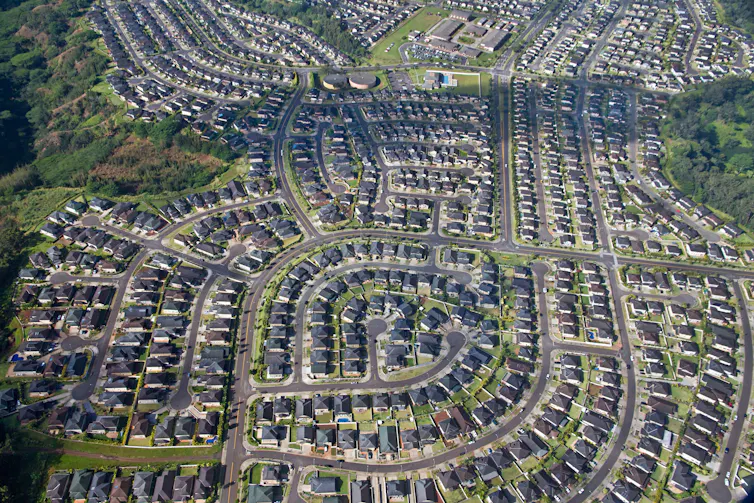
The grass isn’t greener in the outer ‘burbs

Urban expansion is driving people further out, and it’s unsustainable. www.shutterstock.com

Robert Nelson, Monash University

For a long a time real estate close to the palace was socially desirable, and anyone with aspirations didn’t want to know about the rest.

Today in Melbourne inner-city people are embarrassed to reveal knowledge of the outer suburbs such as South Morang, like 17th century Parisians who would mispronounce the street-names of poorer areas or affect not to know them at all.

Throughout history, the distribution of wealth has had a geographical expression. Snobbery, however, is only part of the challenge of urban geography.

Power and privilege are concentrated within 10kms of the city centre. Within this zone are expensive schools, galleries, cafes, majestic parks, concerts, grand buildings and much that a Parisian might recognise, all within cycling distance. The closer to the city you get the more railway stations and tram lines they are, as the public transport network converges on the centre.

Beyond the ring road

Services and destinations thin out the further out you go. That’s where the less well-off live. It’s a long drive to school, work, shops, doctors, or leisure centres. The dominant mode of transport is by car, which creates congestion. Families lose time to frustrating commutes. The roads are deadly for bikes and demoralising by foot. Bus services are few and far between.

To be less well-off means to endure greater hardship: less fun time and more grind; and fewer amenities and opportunities for yourself and children. In a society with egalitarian traditions, this disparity of wealth is ugly.

When inequity has a geographical expression, compensations are invoked as if by reflex. There is a compelling case to redress the terms of disadvantage. These calls to pour money into the outer city — a modest $10 billion — have great moral force, matching the positive discrimination that already operates in universities, where low socio-economic status is defined geographically.

On top of the enlightened ethical basis of these calls to reform and greater funding for the expanding outer suburbs, there are pragmatic reasons for politicians to listen: the outer areas form swinging electorates.

It’s a convincing case in many ways, except for one, which is cripplingly difficult to deal with. And here’s the moral rub.

Sprawling problem

Since the 1970s, we have known that the sprawl is ecologically, economically and socially damaging. Authors have written protests against the trend, objecting to the exorbitant cost of providing services and warning of the reliance on motor transport. Alas these monitory counsels have always fallen on deaf ears. The suburbs have grown consistently and inexorably.

This is in part due to the inner areas, which don’t want to accommodate more people. Protecting the low density of the inner suburbs of Australian cities, the outer suburbs have grown ever outward.

People use the phrase “voted with their feet”, as if an exodus to the outer suburbs is a consumer choice, and suburban growth its logical outcome. A house and garden 30kms out is more appealing than an inner suburban flat. By expressing this as a choice of lifestyle, we fail to acknowledge that many have been denied choice by established, inner suburbs. Inner suburbs have made the choice for the outer city by jealously protecting their own low-density living.

Crimes against sustainability

For anyone with a memory of reasoned resistance to the sprawl, it now seems a bit rich to hear complaints from the fringes that the people who have voted with their feet are now tired of their cars. For the better part of 40 years, the community has been advised that the expansion is stupid. Now the people who went ahead regardless are visiting us with the cost of their mistake. But remember, it isn’t just ‘their’ mistake but the logical consequence of our collective mistake, namely to protect the sparsity of established suburbs that enjoy so many amenities.

Thanks to the worst planning in the world, we are left with a very ugly predicament.

On egalitarian grounds, the outer suburbs need to be propped up with subsidised services; and the more we provide them, the more we mask the true costs and negate the natural disincentives for further expansion.

We should have added extra tax to outer suburbs and actively discouraged their growth. Alas, now that they’ve been built and people are forced out, the money flows in the opposite direction and props up their unsustainable (if difficult) fortunes.

Invoking social justice at this juncture is understandable but also insidious. Poorer people are undoubtedly the victims. The one concept however that never translates into action is sustainability. Maybe we should only discuss the social and economic woes of the outer suburbs once the crimes against sustainability are confessed and strategies are firmly in place to demand that all future growth has to be where abundant services and infrastructure already exist.

Robert Nelson, Associate Director Student Experience, Monash University

This article is republished from The Conversation under a Creative Commons license. Read the original article.

From Regional Landscape & Open Space to Resource and Landscape Planning 2004 -­ 2012

Over 8 years, in collaboration with the Regional Landscape & Open Space Advisory Committee and stakeholders across government and industry, successfully envisioned, researched, developed and, in some cases, implemented many significant policies, frameworks, strategies, action plans and reports in the resource and landscape planning and open space arena. Some, but not all, are set out in this report.

Key achievements: 2004 – 2012

o Regional Landscape & Open Space Advisory Committee established to succeed the Regional Landscape Strategy Advisory Committee (1997-2003)

o Queensland Greenspace Strategy

o Regional Landscape Planning “Body of Knowledge”

o SEQ Greenspace Network Plan

o SEQ State of Region Report

o Strategic Cropping Land Strategy

o SEQ Active Trails Strategy

• Brisbane Valley Rail Trail Plan and 96km of trail open

• Maroochy River Trail Plan and works completed

• Boonah to Ipswich Trail Plan and 49km of trail open

• Kingaroy to Theebine Trail (Business Plan &Feasibility Study) and key rail assets secured.

o Queensland Outdoor Recreation Strategic Framework

o SEQ Outdoor Recreation Strategy (service providers “mapped”)

o SEQ Scenic Amenity methodology

o SEQ Scenic Amenity Planning Guidelines & Mapping

o SEQ Rural Futures Strategy

o SEQ Rural Precinct Planning Guidelines

o SEQ Outdoor Recreation Demand Studies

o Sustainable Poultry Strategy

o Water Sensitive Urban Design Planning Guideline

o North East Gold coast land use and infrastructure strategy

o Landscape heritage discussion papers

o Indigenous landscape heritage research

o Peri-urban Planning research

o Rural and Greenspace Policy Forum

 Greenspace Working Group

 Outdoor Recreation Working Group

 Rural Futures Working Group

o Regional Landscape Forums:

Living landscapes (Boonah)

 Landscape Corridors (Esk)

Greenspace Planning (BFP)

Regional Recreation Trails Planning (BFP)

Environmental planning student forums (RLOSAC annually)

o SEQ Regional Plan : policy development/review, coordination & implementation

SEQ Regional Plan Desired Regional outcomes 1-5 and 7

The regional landscape planning framework

• Regional landscape areas

• Regional landscape values

• Scenic amenity

• Landscape heritage (indigenous and non-indigenous)

• Outdoor recreation

• Community greenspace

• Inter-urban break planning

• Rural futures

• Natural resources

o Other regional initiatives: key stakeholder/contributor to:

 CEOs Committee for NRM in SEQ

 SEQ Natural Resource Management Plan

 SEQ Ecosystem Services Framework

 Flinders Karawatha Corridor

 Peri-urban research

 Monitoring Reporting and Evaluation framework

Industry Recognition of Achievements

Since 2004, the work of the Branch was regularly recognised for its achievements. Through collaboration with State agencies, universities, local governments, and NGOs, the Branch has been recognised for achievements, including:

Queensland Outdoor Recreation Federation – 2010 Government Achievement Award: South East Queensland Outdoor Recreation Strategy

Planning Institute of Australia Queensland Division – 2010 Certificate of Merit for the Decision Support Tool for Local Government Planners Integrating SEQ Regional Natural Resource Management Plan Targets into Local Government Planning Schemes

Planning Institute of Australia (PIA) National Council and National Awards- 2010 Planning Minister’s Award: South East Queensland Natural Resource Management Plan 2009-2031

Planning Institute of Australia Queensland Division – 2009 Overall winner and Planning Scholarship, Research and Teaching Award for Excellence Identifying and Incorporating Indigenous Landscape Values into Regional Planning Processes led by the Urban Research Program, Griffith University.

Queensland Outdoor Recreation Federation – 2010 Government Achievement Award: Brisbane Valley Rail Trail

Planning Institute of Australia Queensland Division – 2009 Regional Planning Achievement Excellence Award: South East Queensland Natural Resource Management Plan 2009-2013

Planning Institute of Australia Queensland Division – 2009 Certificate of Merit: North East Gold Coast Land Use Economic and Infrastructure Strategy

Planning Institute of Australia Queensland Division – 2008 Certificate of Merit: Brisbane Valley Rail Trail Plan

Planning Institute of Australia Queensland Division – 2008 Award for Excellence: South East Queensland Ecosystem Services Project

Queensland Outdoor Recreation Federation – 2008 Certificate of Appreciation: 5th Biennial National Tracks and Trails Conference

Planning Institute of Australia Queensland Division- 2007 Certificate of Merit: Policy and Planning Framework for Urban Water Sensitive Design in South East Queensland

Planning Institute of Australia (PIA) National Council and National Awards – 2006 Planning Ministers’ Award: South East Queensland Regional Plan and Infrastructure Plan; Office of Urban Management, Queensland Department of Local Government and Planning

Planning Institute of Australia Queensland Division- 2005 Award for Excellence: Scenic South East Queensland 2004 Public Preference Survey.

The Landscape Planning team signs off in September 2012

Thank’s for all your help, advice & support folks!

FAREWELL, ADIOS, CIAO, AU REVOIR, CHEERS, AUF WEIDERSEHEN MERCI, GRACIAS, GRAZIE, DANKESCHON

UNTIL WE MEET AGAIN…….

Steve MacDonald, Dave Batt (Batty), John Rush (JR), Bill MacFarlane, Marie Patamise, Peter Kleis and many many more who are gone but not fogotten…

In your backyard: why people need a say on planning that affects their local community

When people weren’t asked about a proposed development in their area, they voiced their opposition. Protect Taringa Facebook page

Written by Philippa England, Griffith University

Good planning needs integrity, and public participation should play a role in that.

But a row over a high-rise development proposed for suburban Brisbane shows what happens when the public feels left out of the planning process.

This highlights the problem with what is termed performance-based planning, which allows some controversial applications to be approved with little or no input from the community.

A plan submitted

Aged-care provider TriCare first lodged its application to develop a new facility in June 2017.


Read more: It’s easy to get us walking more if we have somewhere to walk to near our home and work


The site it chose was zoned for community facilities and the application was treated under Brisbane City Council’s performance-based planning rules as “code assessable development”.

Even though the developer was not required to give notice of the proposal to the local community, people soon got wind of it. They mobilised strong opposition to the planned development.

The developer was proposing three buildings of eight, 12 and 16 storeys in a locality characterised by dwellings that are mostly one to three storeys high.

In November 2017, the council rejected the application. The developer appealed.

TriCare then modified the proposal to the council’s satisfaction and the Queensland Planning and Environment Court approved the negotiated deal last month.

The approved design is for three buildings ranging from seven to eight storeys, a very significant scaling down of the original proposal.

Still no public consultation

But once again the local community was not involved in any of the negotiations or the court proceedings. This is because no community appeals are allowed on code assessable development.

Would the developer have got what it originally wanted if the community had not shown its opposition? And why didn’t the court even consider the community’s point of view?

The answer to these questions lies partly in the legal framework for code assessable development.

In Queensland, code assessable development is considered a bounded form of assessment, which means it should be considered primarily against a planning scheme’s codes. The original aim was to speed up approvals for development applications broadly consistent with a council’s planning scheme.

These codes are written in a performance-based way. This means developers that only meet the overall outcomes of a code can still get their proposals across the line no matter what the code’s finer details state.

Overall outcomes are very often just that – broad statements of intent open to many different interpretations.

For example, in the TriCare case the applicable overall outcomes required development to be “generally consistent with the character of the area” and to “complement the prevailing, scale, height and bulk of expected development in the locality”.

The council – and the community – believed the initial application did not comply with these terms. The developer’s appeal argued its proposal was “generally consistent” with the character of the area as there were at least some medium-to-high-rise buildings in the area, including one nine-storey residential building on adjacent land.

Contrary to the council’s view, the developer argued:

The proposed development is of a scale, bulk and height that provides a high level of amenity and transitions sensitively to surrounding uses.

Evidently, code assessment is not quite the bounded and uncontroversial form of decision-making the legislators intended.

Planning with the community

In planning, good decision-making needs integrity. It needs to provide decisions the community knows to expect including, where appropriate, conditions that protect and respond to the needs of the community.


Read more: ’30-minute city’? Not in my backyard! Smart Cities Plan must let people have their say


In Queensland, the parameters of performance-based planning have swung too far in favour of flexibility. We need to improve the drafting of performance-based codes.

Requirements to be “generally consistent with the character of the area” serve no useful purpose if the character of an area is hybrid, or has different meanings for the short- and long-term residents of that area.

There is also a huge distinction between code assessable development – where community members have no right of appeal – and impact assessable development – where public notification and third party appeal rights apply.

Yet whether applications are classed as impact or code assessable is a matter left to the discretion of individual councils with very little input from the community.

Further guidance needs to be given to better match assessment categories with community concerns.

Flexibility and discretion have a role to play in good planning. But if integrity, honesty and public trust are also goals then transparency and public accountability should be increased.

The value of public participation – both in its contribution to better design and for keeping the system accountable and honest – needs to be genuinely recognised and valued.


Read more: New Queensland planning law puts transparency and accountability at risk


Not all development applications may warrant public appeal rights but a place at the table for the community somewhere along the line is surely warranted.

The Taringa development was initially assessed under legislation that has been superseded. But, as I warned last year, Queensland’s new Planning Act has done little to nothing to resolve the fundamental concerns this case raises.

The divisive story of the aged-care development in Taringa serves as a timely warning to other states looking to shift to a performance-based planning model.

Philippa England, Senior Lecturer, Griffith Law School, Griffith University

This article is republished from The Conversation under a Creative Commons license. Read the original article.

Power of Community Conference

INSIGHTS, STRATEGIES AND TOOLS TO SUPPORT COMMUNITY ORGANISATIONS

Do you work for a small community organisation?
Are you looking for expert advice and support?

Are you keen to learn strategies to improve your organisation’s mission?
  

With a focus on creating change at a local level, the Power of Community Conference is a combination of presentations from nonprofit experts, including the importance of storytelling, how to attract grants, when and how to innovate and the importance of resilience and wellbeing and hands-on roundtables and workshops on four key areas including marketing, fundraising, volunteer management and governance. 
 

The cost to attend this full-day conference is $47 per person (which includes catering). This cost is low so that as many grassroots organisations as possible are able to attend.

Thursday 21 Nov, 2019
8:00am – 5:00pm   

Cost: $47.00pp


Entry to a prize draw where the winner receives one-on-one mentoring from nonprofit experts

Access to organisations and businesses supporting nonprofits via the expo which will be running between sessions

Continued engagement post the conference with webinar series.

Who should come?

CEOs, managers and staff of small to medium-sized nonprofits and social enterprises

Nonprofit board members

Fundraisers
      
Grant seekers

Volunteers.

Why you must attend

Inspiring presentations by nonprofit leaders who are experts in their fields

Interactive roundtables aimed at sharpening your communication and storytelling skills

Workshops designed to build your skills in marketing, fundraising, volunteer management and governance

Real-world, practical strategies and advice you can put into practice immediately

Networking opportunities with like-minded colleagues and sector leaders

More information online

https://www.qut.edu.au/business/about/events/the-power-of-community-conference