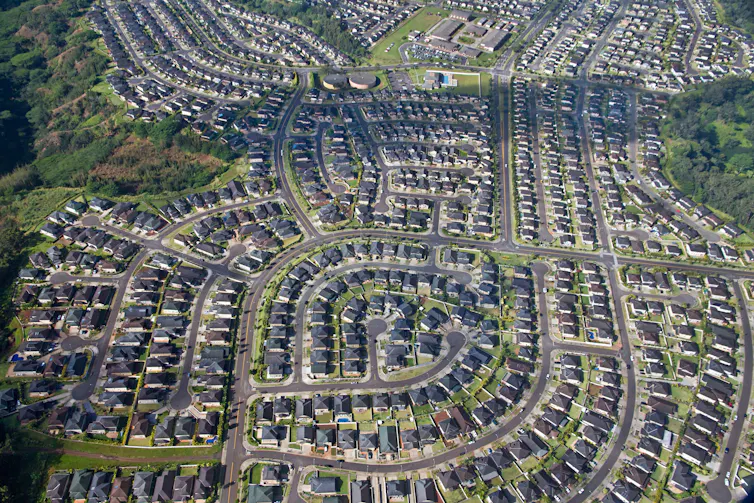
The grass isn’t greener in the outer ‘burbs

Urban expansion is driving people further out, and it’s unsustainable. www.shutterstock.com

Robert Nelson, Monash University

For a long a time real estate close to the palace was socially desirable, and anyone with aspirations didn’t want to know about the rest.

Today in Melbourne inner-city people are embarrassed to reveal knowledge of the outer suburbs such as South Morang, like 17th century Parisians who would mispronounce the street-names of poorer areas or affect not to know them at all.

Throughout history, the distribution of wealth has had a geographical expression. Snobbery, however, is only part of the challenge of urban geography.

Power and privilege are concentrated within 10kms of the city centre. Within this zone are expensive schools, galleries, cafes, majestic parks, concerts, grand buildings and much that a Parisian might recognise, all within cycling distance. The closer to the city you get the more railway stations and tram lines they are, as the public transport network converges on the centre.

Beyond the ring road

Services and destinations thin out the further out you go. That’s where the less well-off live. It’s a long drive to school, work, shops, doctors, or leisure centres. The dominant mode of transport is by car, which creates congestion. Families lose time to frustrating commutes. The roads are deadly for bikes and demoralising by foot. Bus services are few and far between.

To be less well-off means to endure greater hardship: less fun time and more grind; and fewer amenities and opportunities for yourself and children. In a society with egalitarian traditions, this disparity of wealth is ugly.

When inequity has a geographical expression, compensations are invoked as if by reflex. There is a compelling case to redress the terms of disadvantage. These calls to pour money into the outer city — a modest $10 billion — have great moral force, matching the positive discrimination that already operates in universities, where low socio-economic status is defined geographically.

On top of the enlightened ethical basis of these calls to reform and greater funding for the expanding outer suburbs, there are pragmatic reasons for politicians to listen: the outer areas form swinging electorates.

It’s a convincing case in many ways, except for one, which is cripplingly difficult to deal with. And here’s the moral rub.

Sprawling problem

Since the 1970s, we have known that the sprawl is ecologically, economically and socially damaging. Authors have written protests against the trend, objecting to the exorbitant cost of providing services and warning of the reliance on motor transport. Alas these monitory counsels have always fallen on deaf ears. The suburbs have grown consistently and inexorably.

This is in part due to the inner areas, which don’t want to accommodate more people. Protecting the low density of the inner suburbs of Australian cities, the outer suburbs have grown ever outward.

People use the phrase “voted with their feet”, as if an exodus to the outer suburbs is a consumer choice, and suburban growth its logical outcome. A house and garden 30kms out is more appealing than an inner suburban flat. By expressing this as a choice of lifestyle, we fail to acknowledge that many have been denied choice by established, inner suburbs. Inner suburbs have made the choice for the outer city by jealously protecting their own low-density living.

Crimes against sustainability

For anyone with a memory of reasoned resistance to the sprawl, it now seems a bit rich to hear complaints from the fringes that the people who have voted with their feet are now tired of their cars. For the better part of 40 years, the community has been advised that the expansion is stupid. Now the people who went ahead regardless are visiting us with the cost of their mistake. But remember, it isn’t just ‘their’ mistake but the logical consequence of our collective mistake, namely to protect the sparsity of established suburbs that enjoy so many amenities.

Thanks to the worst planning in the world, we are left with a very ugly predicament.

On egalitarian grounds, the outer suburbs need to be propped up with subsidised services; and the more we provide them, the more we mask the true costs and negate the natural disincentives for further expansion.

We should have added extra tax to outer suburbs and actively discouraged their growth. Alas, now that they’ve been built and people are forced out, the money flows in the opposite direction and props up their unsustainable (if difficult) fortunes.

Invoking social justice at this juncture is understandable but also insidious. Poorer people are undoubtedly the victims. The one concept however that never translates into action is sustainability. Maybe we should only discuss the social and economic woes of the outer suburbs once the crimes against sustainability are confessed and strategies are firmly in place to demand that all future growth has to be where abundant services and infrastructure already exist.

Robert Nelson, Associate Director Student Experience, Monash University

This article is republished from The Conversation under a Creative Commons license. Read the original article.

From Regional Landscape & Open Space to Resource and Landscape Planning 2004 -­ 2012

Over 8 years, in collaboration with the Regional Landscape & Open Space Advisory Committee and stakeholders across government and industry, successfully envisioned, researched, developed and, in some cases, implemented many significant policies, frameworks, strategies, action plans and reports in the resource and landscape planning and open space arena. Some, but not all, are set out in this report.

Key achievements: 2004 – 2012

o Regional Landscape & Open Space Advisory Committee established to succeed the Regional Landscape Strategy Advisory Committee (1997-2003)

o Queensland Greenspace Strategy

o Regional Landscape Planning “Body of Knowledge”

o SEQ Greenspace Network Plan

o SEQ State of Region Report

o Strategic Cropping Land Strategy

o SEQ Active Trails Strategy

• Brisbane Valley Rail Trail Plan and 96km of trail open

• Maroochy River Trail Plan and works completed

• Boonah to Ipswich Trail Plan and 49km of trail open

• Kingaroy to Theebine Trail (Business Plan &Feasibility Study) and key rail assets secured.

o Queensland Outdoor Recreation Strategic Framework

o SEQ Outdoor Recreation Strategy (service providers “mapped”)

o SEQ Scenic Amenity methodology

o SEQ Scenic Amenity Planning Guidelines & Mapping

o SEQ Rural Futures Strategy

o SEQ Rural Precinct Planning Guidelines

o SEQ Outdoor Recreation Demand Studies

o Sustainable Poultry Strategy

o Water Sensitive Urban Design Planning Guideline

o North East Gold coast land use and infrastructure strategy

o Landscape heritage discussion papers

o Indigenous landscape heritage research

o Peri-urban Planning research

o Rural and Greenspace Policy Forum

 Greenspace Working Group

 Outdoor Recreation Working Group

 Rural Futures Working Group

o Regional Landscape Forums:

Living landscapes (Boonah)

 Landscape Corridors (Esk)

Greenspace Planning (BFP)

Regional Recreation Trails Planning (BFP)

Environmental planning student forums (RLOSAC annually)

o SEQ Regional Plan : policy development/review, coordination & implementation

SEQ Regional Plan Desired Regional outcomes 1-5 and 7

The regional landscape planning framework

• Regional landscape areas

• Regional landscape values

• Scenic amenity

• Landscape heritage (indigenous and non-indigenous)

• Outdoor recreation

• Community greenspace

• Inter-urban break planning

• Rural futures

• Natural resources

o Other regional initiatives: key stakeholder/contributor to:

 CEOs Committee for NRM in SEQ

 SEQ Natural Resource Management Plan

 SEQ Ecosystem Services Framework

 Flinders Karawatha Corridor

 Peri-urban research

 Monitoring Reporting and Evaluation framework

Industry Recognition of Achievements

Since 2004, the work of the Branch was regularly recognised for its achievements. Through collaboration with State agencies, universities, local governments, and NGOs, the Branch has been recognised for achievements, including:

Queensland Outdoor Recreation Federation – 2010 Government Achievement Award: South East Queensland Outdoor Recreation Strategy

Planning Institute of Australia Queensland Division – 2010 Certificate of Merit for the Decision Support Tool for Local Government Planners Integrating SEQ Regional Natural Resource Management Plan Targets into Local Government Planning Schemes

Planning Institute of Australia (PIA) National Council and National Awards- 2010 Planning Minister’s Award: South East Queensland Natural Resource Management Plan 2009-2031

Planning Institute of Australia Queensland Division – 2009 Overall winner and Planning Scholarship, Research and Teaching Award for Excellence Identifying and Incorporating Indigenous Landscape Values into Regional Planning Processes led by the Urban Research Program, Griffith University.

Queensland Outdoor Recreation Federation – 2010 Government Achievement Award: Brisbane Valley Rail Trail

Planning Institute of Australia Queensland Division – 2009 Regional Planning Achievement Excellence Award: South East Queensland Natural Resource Management Plan 2009-2013

Planning Institute of Australia Queensland Division – 2009 Certificate of Merit: North East Gold Coast Land Use Economic and Infrastructure Strategy

Planning Institute of Australia Queensland Division – 2008 Certificate of Merit: Brisbane Valley Rail Trail Plan

Planning Institute of Australia Queensland Division – 2008 Award for Excellence: South East Queensland Ecosystem Services Project

Queensland Outdoor Recreation Federation – 2008 Certificate of Appreciation: 5th Biennial National Tracks and Trails Conference

Planning Institute of Australia Queensland Division- 2007 Certificate of Merit: Policy and Planning Framework for Urban Water Sensitive Design in South East Queensland

Planning Institute of Australia (PIA) National Council and National Awards – 2006 Planning Ministers’ Award: South East Queensland Regional Plan and Infrastructure Plan; Office of Urban Management, Queensland Department of Local Government and Planning

Planning Institute of Australia Queensland Division- 2005 Award for Excellence: Scenic South East Queensland 2004 Public Preference Survey.

The Landscape Planning team signs off in September 2012

Thank’s for all your help, advice & support folks!

FAREWELL, ADIOS, CIAO, AU REVOIR, CHEERS, AUF WEIDERSEHEN MERCI, GRACIAS, GRAZIE, DANKESCHON

UNTIL WE MEET AGAIN…….

Steve MacDonald, Dave Batt (Batty), John Rush (JR), Bill MacFarlane, Marie Patamise, Peter Kleis and many many more who are gone but not fogotten…

In your backyard: why people need a say on planning that affects their local community

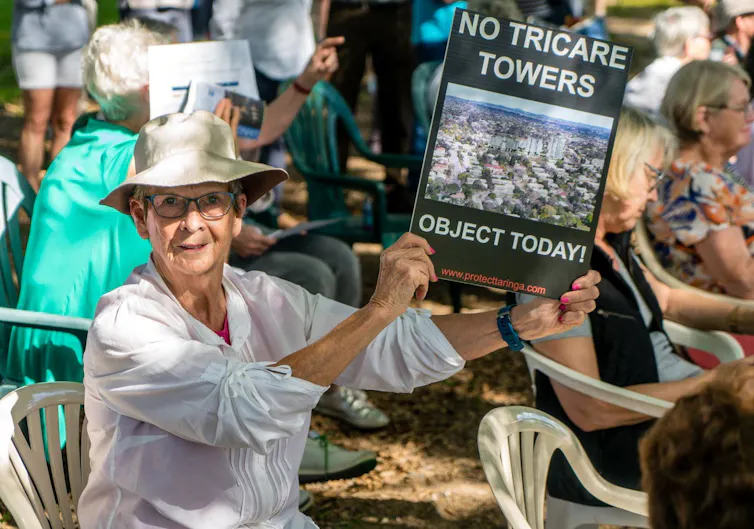
When people weren’t asked about a proposed development in their area, they voiced their opposition. Protect Taringa Facebook page

Written by Philippa England, Griffith University

Good planning needs integrity, and public participation should play a role in that.

But a row over a high-rise development proposed for suburban Brisbane shows what happens when the public feels left out of the planning process.

This highlights the problem with what is termed performance-based planning, which allows some controversial applications to be approved with little or no input from the community.

A plan submitted

Aged-care provider TriCare first lodged its application to develop a new facility in June 2017.


Read more: It’s easy to get us walking more if we have somewhere to walk to near our home and work


The site it chose was zoned for community facilities and the application was treated under Brisbane City Council’s performance-based planning rules as “code assessable development”.

Even though the developer was not required to give notice of the proposal to the local community, people soon got wind of it. They mobilised strong opposition to the planned development.

The developer was proposing three buildings of eight, 12 and 16 storeys in a locality characterised by dwellings that are mostly one to three storeys high.

In November 2017, the council rejected the application. The developer appealed.

TriCare then modified the proposal to the council’s satisfaction and the Queensland Planning and Environment Court approved the negotiated deal last month.

The approved design is for three buildings ranging from seven to eight storeys, a very significant scaling down of the original proposal.

Still no public consultation

But once again the local community was not involved in any of the negotiations or the court proceedings. This is because no community appeals are allowed on code assessable development.

Would the developer have got what it originally wanted if the community had not shown its opposition? And why didn’t the court even consider the community’s point of view?

The answer to these questions lies partly in the legal framework for code assessable development.

In Queensland, code assessable development is considered a bounded form of assessment, which means it should be considered primarily against a planning scheme’s codes. The original aim was to speed up approvals for development applications broadly consistent with a council’s planning scheme.

These codes are written in a performance-based way. This means developers that only meet the overall outcomes of a code can still get their proposals across the line no matter what the code’s finer details state.

Overall outcomes are very often just that – broad statements of intent open to many different interpretations.

For example, in the TriCare case the applicable overall outcomes required development to be “generally consistent with the character of the area” and to “complement the prevailing, scale, height and bulk of expected development in the locality”.

The council – and the community – believed the initial application did not comply with these terms. The developer’s appeal argued its proposal was “generally consistent” with the character of the area as there were at least some medium-to-high-rise buildings in the area, including one nine-storey residential building on adjacent land.

Contrary to the council’s view, the developer argued:

The proposed development is of a scale, bulk and height that provides a high level of amenity and transitions sensitively to surrounding uses.

Evidently, code assessment is not quite the bounded and uncontroversial form of decision-making the legislators intended.

Planning with the community

In planning, good decision-making needs integrity. It needs to provide decisions the community knows to expect including, where appropriate, conditions that protect and respond to the needs of the community.


Read more: ’30-minute city’? Not in my backyard! Smart Cities Plan must let people have their say


In Queensland, the parameters of performance-based planning have swung too far in favour of flexibility. We need to improve the drafting of performance-based codes.

Requirements to be “generally consistent with the character of the area” serve no useful purpose if the character of an area is hybrid, or has different meanings for the short- and long-term residents of that area.

There is also a huge distinction between code assessable development – where community members have no right of appeal – and impact assessable development – where public notification and third party appeal rights apply.

Yet whether applications are classed as impact or code assessable is a matter left to the discretion of individual councils with very little input from the community.

Further guidance needs to be given to better match assessment categories with community concerns.

Flexibility and discretion have a role to play in good planning. But if integrity, honesty and public trust are also goals then transparency and public accountability should be increased.

The value of public participation – both in its contribution to better design and for keeping the system accountable and honest – needs to be genuinely recognised and valued.


Read more: New Queensland planning law puts transparency and accountability at risk


Not all development applications may warrant public appeal rights but a place at the table for the community somewhere along the line is surely warranted.

The Taringa development was initially assessed under legislation that has been superseded. But, as I warned last year, Queensland’s new Planning Act has done little to nothing to resolve the fundamental concerns this case raises.

The divisive story of the aged-care development in Taringa serves as a timely warning to other states looking to shift to a performance-based planning model.

Philippa England, Senior Lecturer, Griffith Law School, Griffith University

This article is republished from The Conversation under a Creative Commons license. Read the original article.
Power of Community Conference

INSIGHTS, STRATEGIES AND TOOLS TO SUPPORT COMMUNITY ORGANISATIONS

Do you work for a small community organisation?
Are you looking for expert advice and support?

Are you keen to learn strategies to improve your organisation’s mission?
  

With a focus on creating change at a local level, the Power of Community Conference is a combination of presentations from nonprofit experts, including the importance of storytelling, how to attract grants, when and how to innovate and the importance of resilience and wellbeing and hands-on roundtables and workshops on four key areas including marketing, fundraising, volunteer management and governance. 
 

The cost to attend this full-day conference is $47 per person (which includes catering). This cost is low so that as many grassroots organisations as possible are able to attend.

Thursday 21 Nov, 2019
8:00am – 5:00pm   

Cost: $47.00pp


Entry to a prize draw where the winner receives one-on-one mentoring from nonprofit experts

Access to organisations and businesses supporting nonprofits via the expo which will be running between sessions

Continued engagement post the conference with webinar series.

Who should come?

CEOs, managers and staff of small to medium-sized nonprofits and social enterprises

Nonprofit board members

Fundraisers
      
Grant seekers

Volunteers.

Why you must attend

Inspiring presentations by nonprofit leaders who are experts in their fields

Interactive roundtables aimed at sharpening your communication and storytelling skills

Workshops designed to build your skills in marketing, fundraising, volunteer management and governance

Real-world, practical strategies and advice you can put into practice immediately

Networking opportunities with like-minded colleagues and sector leaders

More information online

https://www.qut.edu.au/business/about/events/the-power-of-community-conference

Minister calls for a step in the right direction in planning

All new residential developments in Queensland could have more walkable street layouts, better connectivity, footpaths with street trees for shading, and better access to parks and public open space, following the release for public consultation of a new model code for neighbourhood design.

Healthier urban design

In a move designed to improve health and neighbourhood design throughout the state, Minister for Planning Cameron Dick said the new standards could become compulsory for new developments. 

While the SEQ Alliance welcomes the initiative there are concerns that no mention was made of the new code when the Alliance met with the Ministers representatives only a few weeks ago. Other stakeholders were aware of the initiative but the Alliance was kept in the dark.

Minister Dick said “Our built environment has a huge impact on how active and healthy people are. With some relatively simple improvements to the current planning framework, we can better ensure all new developments are walkable and encourage active living, which will help improve the health of all Queenslanders,” Mr Dick said. 

 “We live in a hot climate and in a recent Department of Transport and Main Roads survey 24 percent of Queenslanders said lack of shade and shelter along their walking route was a major barrier to walking in Queensland. 

“This code is about getting the fundamentals of new development right, creating walkable, grid-like street layouts, better connectivity, footpaths with street trees for shading, and better access to parks and public open space.”

A new code by 2020

Mr Dick said elements of the model code could be become mandatory by the end of 2019. 

“While some councils and developers are exceeding the benchmarks we are setting, we want to make sure all new development meets community expectations,” he said. 

“This will provide greater certainty for the development community about what is expected of new development and ultimately provide better designed communities for home buyers and renters.”

Elements of the code which could become mandatory by the end of the year include: 

  • Grid-like street networks with fewer cul-de-sacs 
  • footpaths complemented by street trees on both sides of most streets
  • street blocks no longer than 130m with longer blocks having mid-block pedestrian breaks
  • parks and open spaces within comfortable walking distance of every dwelling. 

Limited consultation

Heart Foundation Queensland CEO, Stephen Vines, said walking-friendly neighbourhoods were needed to get residents more active and address the state’s growing obesity crisis.

“Too many Queenslanders are missing out on the physical activity they need for good heart health, so we must find ways to encourage residents to get moving and leave the car at home more often,” Mr Vines said.

“Neighbourhood design plays an important role in building healthier communities, and we’re pleased to see this model code includes Healthy Active by Design principles from the Heart Foundation.

“There is a great deal of research that proves better designed communities provide health and economic benefits by encouraging physical activity and reducing heart disease – our biggest killer.”

Urban Development Institute of Australia (UDIA) Queensland CEO, Kirsty Chessher-Brown, said it was important the industry worked together to ensure good health outcomes for all new communities. 

“The design of new communities can have an impact on how healthy and active people are so it’s important we all play our part to support healthier communities,” Ms Chessher-Brown said. 

“The UDIA supports measures that seek to provide healthy and active communities across the state and supports the development of model codes which encourage the provision of walkable environments.” 

Consultation underway

Mr Dick said this was a policy for the community and feedback would be sought on how best to make our communities more active, connected and safe. 

“Whether you live in an inner-city suburb or a remote part of Queensland, this is a policy with benefits for every Queenslander,” he said. 

“I want to hear from all Queenslanders about the challenges they have in their neighbourhoods, from lack of footpaths to poor shading, and what we can do to improve these things in new developments. 

“We want Queenslanders to be able to move easily and comfortably around their neighbourhood. 

Consultation is open until 1 September 2019. To find out more and to have your say visit qld.gov.au/healthycommunities 

To view the new model code go to: https://planning.dsdmip.qld.gov.au/planning/better-planning/state-planning

Town planning – a critical social justice issue

Melbourne and Sydney could be heading for between eight and ten million people each by 2050.

We are failing to manage this growth by not building sustainable, resilient communities. Indeed, we are at the point where we risk leaving a disastrous legacy for future generations.

Good town planning is often not perceived as a high priority social justice issue in wider society. This may be because issues such as homelessness, income inequality and carbon emissions are considered more immediate, pressing issues. However, good town planning underpins so many of these environmental and social justice issues that ignoring it would be a major setback for creating long-term sustainable, low-carbon communities.

Professor Peter Newman at Curtin University has described our outer suburbs as the “slums of the future” due to their car dependency and vulnerability to oil shocks. Many Australian outer suburbs are also vulnerable as they often rely on the inner-city for employment opportunities and essential services. His solution is to build upwards, not outwards, by means of urban consolidation.

However, this fix has shown to be problematic. Professor Bill Randolph of the City Futures Research Centre at University of New South Wales has described most of the new higher-density developments in inner-city areas as “vertical slums” due to the very poor quality in which many are built, especially as they are aimed at investors and short-term renters rather than providing quality long-term homes.

The truth is that we are building both new outer suburban and high-rise slums in our capital cities at unprecedented rates and the scale is staggering. Melbourne alone will need two million extra residences by 2050. Due to this ongoing urban sprawl, the city’s food bowl could decline from 41 per cent of its current self-sufficiency to 18 per cent by 2050.

There have been so many skyscraper approvals in Melbourne’s CBD in recent years that the density in Melbourne’s centre is higher than the legal limits in Hong Kong or New York — and many town planners predict it will continue to grow. The building standards in Victoria are low by world standards, and many apartments are fitted with potential safety issues such as flammable cladding, imported asbestos and other cost-saving materials.

It costs a lot to house a city that is growing on average by almost 100,000 people per year. It has been estimated that – if national growth predictions are correct – infrastructure costs may amount to at least half a trillion dollars of the Federal budget over the next 40 years. Australia is currently five years behind in the infrastructure required by its current population and needs, which includes schools, hospitals, TAFEs, neighbourhood houses and so on. It is predicted that the Victorian State Government will invest so much in road infrastructure over the next 20 years that there will be precious little for much else — certainly not public transport, which is currently at peak capacity. Most other states are experiencing similar crises with their infrastructure budgets.

It should not be a surprise that big business mostly will not foot the infrastructure bill. Long gone are the days when property developers were required to input infrastructure costs when designing new suburbs. In the United States, for example, prior to WWII, it was a requirement for property developers to build new tram lines whenever they built new suburbs. These days, the public funds new infrastructure projects either through toll roads, rising utility bills or by exponentially rising house prices.

Town planning and inequality

Otherwise, infrastructure costs are paid by our taxes at the expense of other services, such as schooling, health and social services. Of course, property developers and big businesses reap the rewards through ever-rising house prices, propped up by tax incentives such as negative gearing. Given that an entire generation of young people is being priced out of the housing market, current town planning practices are further cementing a future of inequality between haves and have-nots.

There is an environmental cost too. It takes a lot of resources and mining to pour concrete over our food bowls and the impact to local animal and wildlife has been devastating — and will continue to be so.

Good, sustainable town planning results in communities that are permeable and walkable, with easy access to services, jobs, public transport and natural green spaces. These communities offer a variety of housing options, such as medium density townhouses or larger family dwellings to cater for the fact that people have different housing needs and that individuals’ needs change over the course of their lives. Good designs do not create a dichotomy of high-rise vs sprawl, nor do they rapidly demolish existing housing stock, as this creates displacement within communities.

Ideally, new buildings would be designed for high-energy efficiency, be built from sustainable materials, have affordable access to solar panels and rainwater tanks and include co-housing options. There are occasional examples of these initiatives already in our capital cities: Melbourne has The Commons in Brunswick (an eco-friendly high-rise in the inner city) and Murundaka (suburban co-housing). While it’s great they exist, the tragedy is that they are the exception and not the norm and when they do exist, they are often appropriated by developers as an excuse to raise prices and make these places exclusive.

The reality is that unsustainable town planning processes will continue as long as the main drive behind their construction is profit. Why bother putting effort into your investment property when you know it will double in value anyway? Both negative gearing and population stressors on housing supply will make this possible.

Solving our town planning issues

What are the answers? Town planning is a very complex issue and there are as many ideas to solve our issues as there are town planners. These include tiny houses, co-housing communities, permaculture villages — the list goes on. I believe change is not possible without the following:

  1. Significant changes to the following policies: political donations, negative gearing and capital gains tax concessions. This would mitigate the lobbying power interest groups have toward government policies on town planning. This includes property developers, the banking sector and individuals of high-existing wealth and capital in the property market.
  2. Increase the power of local government so that communities are empowered to influence town planning decisions within their own jurisdictions.
  3. Town planning policies in which minimum standard practice includes sustainable housing design, co-housing options, as well as access to public transport nodes, natural green spaces, and community services and gardens.
  4. A society that is less focused on “jobs and growth”, and more focused on creating resilient communities that are self-sufficient and contribute, rather than complicate, a path towards a low carbon future. To do so, we will need to have some tough conversations, including a discussion on population policy. It is very difficult to build indefinitely for a country that could be heading towards 42 million people by 2050 and 70 million by 2100, with no endpoint on the horizon. At the very least, population policy should not be influenced by the lobbying influence of big businesses.

Town planning design plays a significant role in the way we live and how we interact with our community and environment. Therefore, good (or bad) town planning decisions have an ongoing effect on many other social justice issues.

Written by Michael Bayliss


Michael Bayliss has been active within environmental and post-growth movements over  the past decade. He co-founded Population Permaculture and Planning (PPP) in 2015 as a means to communicate the critical role that town planning plays in the move towards future sustainable communities. PPP has since delivered workshops to activists and environmentalists across Australia. Michael has been involved with Sustainable Population Australia since 2013, in such roles as Victoria and Tasmania branch president and currently as national communications manager.


(This article was originally published 18/02/2018 for Independent Australia titled:  Growth, infrastructure and town planning: Cementing a sustainable future)

Published by Redlands2030 – 6 July 2019